
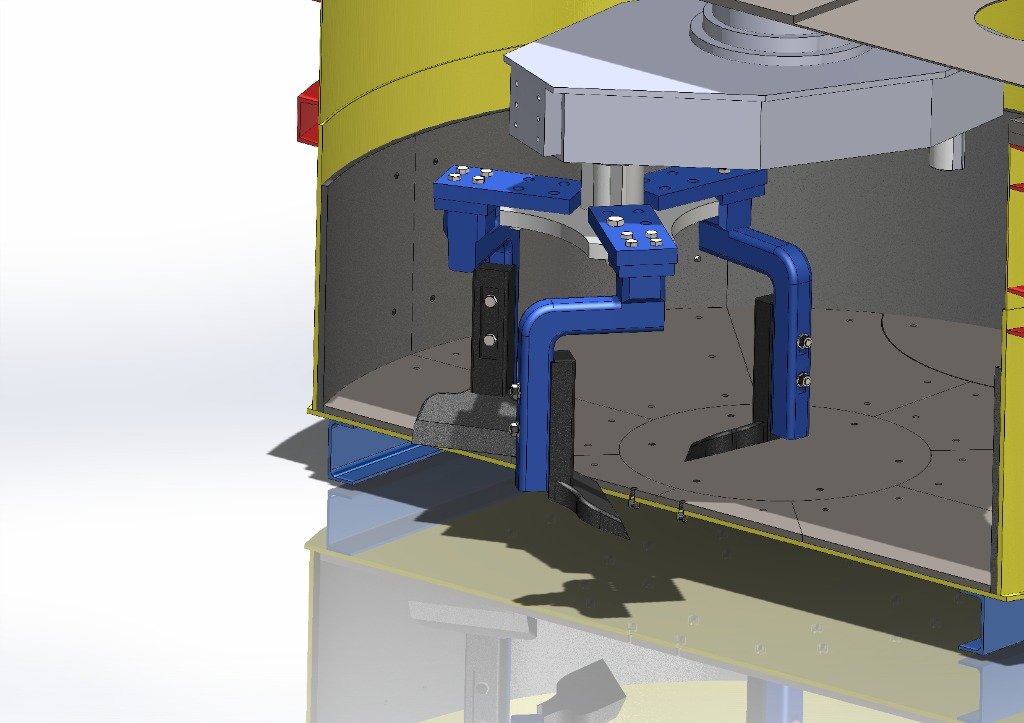
Planetary motion concrete mixing
Ultra High Performance Concrete (UHPC) and Self Compacting Concrete (SCC) are revolutionizing the modern precast and construction industries. As structural demands shift toward longer spans, thinner sections, and greater environmental durability, standard concrete formulations are no longer sufficient. Achieving compressive strengths exceeding 150 MPa in UHPC or high flowability in SCC requires a scientific approach to aggregate distribution, chemical admixtures, and high shear mechanical blending. In these high performance concrete applications, the planetary concrete mixer emerges as the essential mechanical factor, moving far beyond legacy single axis pan mixing systems to achieve total batch homogeneity.
This comprehensive guide explores the physics, kinematics, and operational advantages of planetary motion in concrete mixing, demonstrating why counter current agitation is crucial for achieving the mechanical properties required in modern construction infrastructure.
The Physics and Kinematics of Counter Current Planetary Mixing
To understand why planetary motion is superior, one must analyze the physical path of the mixing blades. Traditional pan mixers rely on a stationary pan with paddles rotating on a single central vertical axis. This mechanism relies heavily on gravity and passive aggregate displacement to blend material. In dry or highly viscous mixes, this single motion leads to severe segregation, aggregate crushing, and stagnation zones near the center and outer walls of the pan.
A planetary mixer completely re-engineers this movement by introducing dual motion kinematics. The mixer consists of one or more mixing stars (turrets) that revolve around the central axis of the pan. Simultaneously, each mixing star contains multiple mixing paddles that rotate rapidly on their own vertical axis. This combined rotation and revolution creates a counter current trajectory. Every square centimeter of the mixing pan floor is swept by a high velocity blade within a fraction of a second, leaving zero dead zones.
The dual axis motion accelerates material velocity vectors in three dimensions. As aggregates are lifted, sheared, and forced to collide from opposing directions, the physical forces break down particle agglomerates with extreme efficiency. This high intensity shearing ensures that liquids, binders, and aggregates are dispersed uniformly without relying on prolonged mixing cycles that could crush soft aggregates or generate excessive friction heat.
Mixing Mechanics of Ultra High Performance Concrete (UHPC)
Ultra High Performance Concrete is defined by its compact particle packing density and extremely high compressive and tensile strengths. Producing UHPC involves using very fine powders (cement, quartz flour, and micro silica) combined with a low water to binder ratio (often between 0.15 and 0.20) and high volumes of steel or synthetic fibers. This formulation presents two major challenges during the batching phase: powder de-agglomeration and fiber dispersion.
De-agglomerating Ultra Fine Binders
Micro silica (silica fume) is a key component of UHPC, filling the microscopic gaps between cement grains to create a dense matrix. Because micro silica particles are extremely small (average size of 0.1 microns), they carry high surface charges and clump together into electrostatic agglomerates. If these clumps are not broken down during mixing, they remain as unhydrated pockets, creating weak points in the cured concrete structure.
A standard concrete mixer lacks the localized shear stress required to overcome these electrostatic forces. The counter current action of a planetary mixer, however, applies concentrated mechanical energy directly to the paste. As the blades shear the material against the pan floor and wear liners, the high intensity velocity differentials tear the silica fume clusters apart. This ensures that every individual micro particle is hydrated and distributed evenly, maximizing the pozzolanic reaction and concrete density.
Ensuring Homogeneous Fiber Dispersion
To achieve high tensile strength and ductility, UHPC mixes typically incorporate steel fibers (often 2% to 6% by volume). If these fibers are not distributed uniformly, they tend to entangle, forming fiber balls or nests. Fiber nesting not only weakens the structural member by leaving zones without reinforcement but can also jam discharge gates and placement hoses.
Planetary mixers resolve this by continuously changing the direction of the mixing forces. The dual motion blades split the aggregate stream, preventing fibers from aligning in a single plane or twisting together. Instead, fibers are suspended individually within the high viscosity matrix, ensuring multidirectional tensile reinforcement throughout the finished precast element.
Mixing Mechanics of Self Compacting Concrete (SCC)
Self Compacting Concrete is designed to flow under its own weight, filling complex formwork and dense reinforcement layouts without requiring external mechanical vibration. This behavior requires high fluid workability combined with excellent segregation resistance, achieved through high dosages of high range water reducers (HRWR) and viscosity modifying agents (VMA).
The challenge in SCC production is that these chemical admixtures must be fully activated and dispersed at a microscopic level to work effectively. Inadequate mixing leads to delayed chemical activation, where the concrete seems dry at first, prompting operators to add excess water, which eventually causes segregation and bleeding once the chemicals fully react later in transit.
A planetary mixer provides the perfect environment for SCC. The rapid, multidirectional agitation ensures that superplasticizers are distributed evenly across all cement particles. This leads to immediate adsorption, uniform charge dispersion, and predictable workability. The resulting SCC paste is highly cohesive, allowing heavy aggregates to remain suspended in the matrix during transport and placement, eliminating segregation and ensuring smooth, structural finishes.
Color Uniformity in Interlocking Pavers
For manufacturers of interlocking paver blocks, paver tiles, and architectural precast, visual consistency is as important as structural strength. Paver production uses a dry cast or semi dry concrete mix with added synthetic iron oxide color pigments. Because these mixes contain very little water, distributing the pigment evenly is incredibly difficult.
In standard pan mixers, pigment powders often clump together or stick to the pan floor, resulting in color variations, streaks, or spots on the paver surface. A single off color batch can lead to the rejection of an entire delivery, causing substantial financial losses.
By using a planetary mixer, the dry materials undergo intense mechanical shearing before water is added. This dry blending stage distributes the pigment particles uniformly across all sand and aggregate surfaces. When the water is introduced, the pigment is immediately locked in place, ensuring rich, streak free, and identical color shading across every paver block produced day after day.
Conclusion: Why Planetary Mixers are the Ultimate Industry Standard
Investing in a high durability planetary concrete mixer is a strategic business decision that directly affects plant profitability, product quality, and material cost control. By accelerating the mixing cycle, reducing cement and admixture waste, and ensuring structural homogeneity, planetary technology helps precast manufacturers achieve operational excellence.
At Balaji Construction Machines & Spares, we engineer our planetary mixers with a 2.0 Factor of Safety gearbox, premium Ni Hard wear castings, and fully integrated automation systems to deliver unmatched mixing performance. From Satara to major infrastructure projects across India, our mixers help developers turn complex concrete challenges into competitive advantages.
Frequently Asked Questions (FAQ)
What makes UHPC and SCC mixing different from regular concrete?
UHPC utilizes extremely fine silica fume binders and steel fibers with low water ratios, requiring high shear forces to break down agglomerates and distribute fibers. SCC requires immediate, uniform dispersion of superplasticizers and VMAs to flow without aggregate segregation. Both formulations demand high intensity planetary mixing to achieve homogeneity.
How does the dual rotation star gear mechanism eliminate dead zones?
In a planetary mixer, the mixing stars rotate on their own vertical axis while simultaneously revolving around the central pan axis. This counter current dual motion sweeps every coordinate of the pan floor in a fraction of a second, preventing material from settling in stagnated areas or along the pan walls.
Why is planetary motion necessary for paver block color consistency?
Semi dry paver mixes contain very little water, making color pigments prone to clumping. The intense dry blending phase in a planetary mixer distributes iron oxide pigments uniformly across aggregate surfaces before water activation, preventing streaks and batch color variations.
What is the mixing cycle time difference between planetary and standard pan mixers?
Because of the dual motion speed and high shear density, planetary mixers achieve a perfectly homogeneous mix in 2 to 3 minutes, which is 30% to 50% faster than traditional pan mixers. This reduces cycle times and increases overall plant daily production output.