
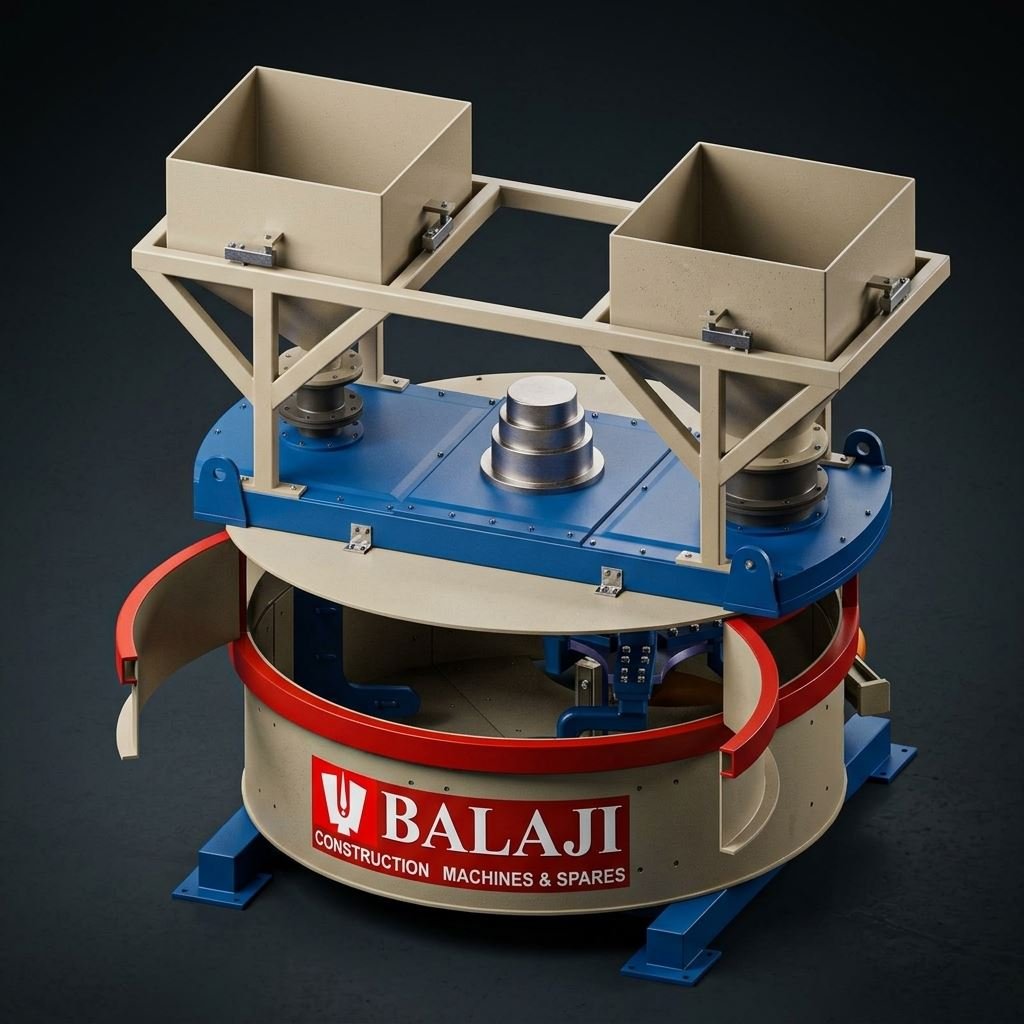
Concrete planetary mixer
What is a planetary mixer?
A planetary mixer is an industrial batch mixing machine featuring a vertical shaft design where the mixing paddles rotate on their own axis while simultaneously revolving around the central axis of the mixing pan. This dual-axis counter-current kinematics ensures 100% floor sweeping coverage with zero stagnant zones, delivering high shear forces to achieve total batch homogeneity in dry, wet, and highly viscous formulations.
In chemical processing, glass manufacturing, refractory production, and concrete batching, the homogeneity of the mixture determines the quality of the end product. Standard mixers that rely on single-axis rotation often fail when blending viscous pastes, fine micro-powders, or fiber-reinforced materials. This mechanical limitation is overcome by the planetary mixer, which uses dual-axis movement to force aggregates to blend from multiple directions simultaneously.
This technical guide details the kinematics, design parameters, and operational advantages of planetary mixers, providing a definitive reference for engineers and plant managers looking to optimize their mixing processes.
1. Kinematics of Planetary Mixing
The defining feature of a planetary mixer is the counter-current trajectory of its mixing arms. In standard mixers, the paddles follow a fixed circular path, meaning materials must passively flow into the blade path. In a planetary mixer, the mixing blades actively travel to every coordinate of the pan.
The drive system utilizes a central sun gear and outer planetary gears. As the main motor turns the central turret, the entire turret revolves around the pan. Simultaneously, the mixing stars (holding the paddles) mesh with the stationary outer ring gear, causing each star to rotate rapidly on its own vertical axis. If the turret revolves at velocity V1 and the star rotates at velocity V2 in the opposite direction, the resulting blade path forms a complex cycloid curve. This overlapping path guarantees that within a few seconds, every aggregate particle is swept, sheared, and forced to blend, leaving zero dead zones near the center or outer walls.
2. Key Design and Engineering Parameters
To ensure reliability in industrial environments, planetary mixers must be engineered with specific design tolerances:
Gearbox Safety Factors
Industrial mixing involves high resistance and starting torque. When mixing low water cement concrete or thick chemical pastes, the gearbox experiences intense shock loads. High quality manufacturers engineer gearboxes with a **2.0 Factor of Safety**. This rating ensures that the gears, bearings, and shafts are designed to handle double the maximum torsional load of the motor, protecting the drive system from catastrophic failures and extending the gearbox life beyond 10,000 operational hours.
Wear Protection and Materials
Aggregates and industrial minerals cause continuous sliding abrasion along the pan floor and walls. Standard structural steel plates erode quickly under these conditions. To maximize equipment life, planetary mixers are lined with high-hardness castings. Segmented **Ni Hard white iron castings** with a minimum Brinell hardness of **550 HB** represent the industry standard. These liners protect the mixer shell, ensuring that the wear rate remains low and uniform, which prevents contamination of the mixture from metal erosion.
3. Critical Applications
Planetary mixers are the preferred choice for industrial processes requiring extreme batch uniformity:
- High Performance Concrete (UHPC/SCC): The high shear forces of a planetary mixer break down micro-silica agglomerates and distribute steel or synthetic fibers evenly, ensuring maximum compressive and tensile strengths.
- Glass Batching: Blending fine sand, soda ash, and cullet requires zero dust loss and absolute uniformity to prevent melting defects in the furnace.
- Refractory Materials: Viscous refractory clays and high-temperature aggregates must be mixed thoroughly to ensure uniform heat resistance in the finished bricks.
- Pigment and Paver Mixing: In dry-cast color pavers, the intense dry-blending phase distributes color pigments evenly across aggregate surfaces before water activation, preventing streaks and color variations.
4. Operational Comparison Table
Here is a technical comparison showing how a planetary mixer performs against traditional vertical shaft pan mixers:
| Parameter | Planetary Mixer | Pan Mixer |
|---|---|---|
| Mixing Path | Cycloidal (Revolution + Counter-rotation) | Circular (Single axis rotation) |
| Dead Zones | 0% (100% floor sweeping coverage) | 5% to 8% (Pockets near center turret) |
| Typical Mixing Time | 2 to 3 minutes | 4 to 6 minutes |
| Coefficient of Variation | < 3% (Extreme homogeneity) | 5% to 8% (Moderate homogeneity) |
| Energy Consumption | Low per batch (Fast cycle efficiency) | High per batch (Longer run times) |
Conclusion: Protecting Your Investment
A planetary mixer is a vital capital asset that directly impacts production quality, material efficiency, and utility costs. By choosing a system engineered with high safety margins, industrial plants can ensure continuous operation, high batch consistency, and low total cost of ownership.
Balaji Construction Machines & Spares manufactures premium planetary concrete mixers at our Satara, Maharashtra facility. Featuring 2.0 safety factor gearboxes, watertight discharge doors, and premium Ni Hard castings, our mixers deliver peak mixing performance under the most challenging industrial conditions. Contact our engineering team today to customize your mixing system.
Frequently Asked Questions (FAQ)
What is a planetary mixer and how does it work?
A planetary mixer is a vertical shaft mixer where the mixing paddles rotate on their own vertical axis while simultaneously revolving around the central axis of the pan. This counter-current dual motion forces aggregates to collide and mix from multiple vectors, achieving total batch homogeneity.
Why is a planetary mixer preferred for UHPC and SCC?
UHPC contains ultra-fine micro-silica and steel fibers that tend to clump due to electrostatic forces. SCC requires immediate dispersion of superplasticizers. A planetary mixer applies localized high shear forces that de-agglomerate fine powders and distribute fibers evenly without nesting.
What is the typical mixing cycle time of a planetary mixer?
Because of its dual-motion speed and high shear density, a planetary mixer achieves a perfectly homogeneous mix in 2 to 3 minutes, which is 30% to 50% faster than standard single-axis mixers.
How does the 2.0 safety factor gearbox protect the mixer?
A 2.0 safety factor rating means the gearbox is engineered to withstand double the maximum torsional load of the motor. This protects the gears from stripping or breaking during high-resistance startup phases or when mixing high-viscosity pastes.
What wear protection is used in planetary mixers?
To resist abrasion from aggregates, planetary mixers are lined with high-hardness castings. Segmented Ni Hard white iron plates with a minimum hardness of 550 HB are used on the floor and walls to ensure uniform wear and prevent shell erosion.