
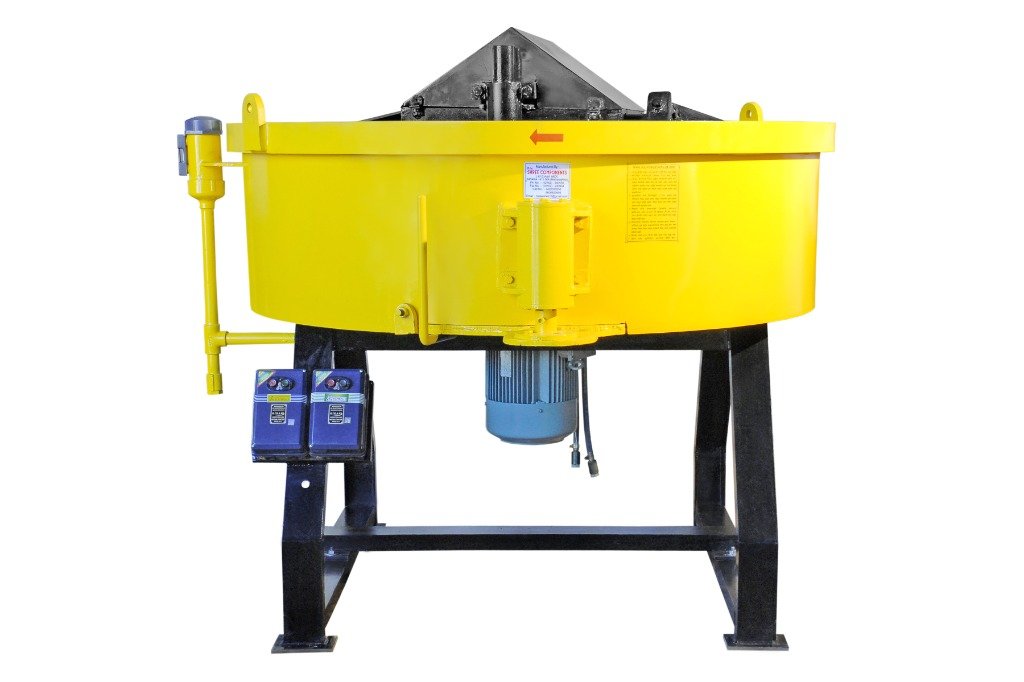
Concrete pan mixer manufacturers Maharashtra
The Indian construction and real estate sectors are witnessing massive growth, driven by rapid urbanization and infrastructure development. With this expansion, the demand for standard building components like fly ash bricks, hollow concrete blocks, interlocking pavers, and precast masonry elements has surged. For brick yard owners and precast manufacturers, maintaining a low cost per unit while ensuring structural strength is the key to business profitability. In these highly competitive markets, the concrete pan mixer stands as the essential workhorse of production.
Selecting the right mixing equipment is no longer just about matching batch volumes; it is about mechanical durability, low utility costs, and ease of local maintenance. This comprehensive guide explores the landscape of concrete pan mixer manufacturers in India, focusing on the technical requirements for standard masonry concrete and why precision engineered equipment remains the benchmark for long term productivity.
The Operating Principles of Concrete Pan Mixers
To understand why pan mixers are preferred for standard brick plants, one must analyze their mechanical design. A concrete pan mixer consists of a stationary cylindrical pan where aggregates, cement, and water are loaded. At the center of the pan, a vertical shaft connected to a heavy duty gearbox rotates at a controlled velocity. Multiple mixing arms with scraper blades are bolted to this central shaft.
As the central shaft rotates, the blades push the aggregates in a circular path. The scrapers continuously clean the inner and outer walls of the cylinder, preventing wet concrete paste from sticking and building up. The mixing action relies on a combination of horizontal displacement and gravity as materials cascade over the rotating arms. Once the mix achieves the desired consistency, a sector gate at the bottom of the pan opens, allowing gravity and the rotating paddles to quickly discharge the batch.
Why Pan Mixers Remain the Standard for Brick and Block Yards
While planetary mixers offer superior shear intensity for complex mixes like UHPC, pan mixers remain the primary choice for standard fly ash brick and concrete block manufacturers in India for several practical reasons:
1. Mechanical Simplicity and Low Maintenance Costs
Pan mixers have a simple drive mechanism consisting of a motor, a vertical gearbox, and a central shaft. They have fewer moving components compared to planetary gearboxes. This simplicity means that local operators and mechanics can easily perform routine maintenance, grease bearings, and replace worn blades without requiring specialized technicians, minimizing downtime in rural or semi-urban brick yards.
2. Low Capital Investment
Starting a fly ash brick yard or a small paver block plant requires managing initial capital expenses carefully. A concrete pan mixer has a significantly lower initial purchase cost compared to a planetary mixer of equivalent volume. This lower investment barrier allows new entrepreneurs to establish manufacturing facilities with lower debt levels, accelerating their path to profitability.
3. Adaptability to Semi Dry Concrete Mixes
Fly ash bricks and interlocking pavers are manufactured using semi dry concrete (often called zero slump concrete). This material has a very low water content and must be compressed under high vibration in molding machines. Pan mixers excel at blending these semi dry, sandy aggregate mixes. The circular dragging motion of the blades forces moisture through the dry aggregate particles without creating massive starting torque surges that could overload planetary gears.
Metallurgical Durability: The Crucial Role of Wear Liners
One of the biggest mistakes made by brick plant owners when choosing a pan mixer manufacturer is neglecting the quality of the wear parts. Sand in India is often rich in silica, making it highly abrasive. Standard mild steel or low grade iron blades wear down in a matter of weeks under continuous dry cast mixing. As the blades wear down, the gap between the paddle and the floor increases, leaving a thick layer of unmixed cement and sand stuck to the bottom of the pan.
At Balaji Construction Machines & Spares, we address this issue by using premium **Ni Hard white iron castings** for all floor liners and mixing blades. Our wear parts are heat treated to a minimum Brinell hardness of **550 HB**. This extreme hardness ensures that our blades resist abrasive scratching, extending their operational lifespan up to 5,000 m³ of throughput. By maintaining a sharp, rigid profile, the blades keep a clean 2mm clearance from the floor liners, ensuring consistent mixing quality and reducing energy load on the motor.
Key Technical Parameters to Consider Before Buying
When evaluating concrete pan mixer manufacturers in India, do not look only at the price tag. Focus on these engineering specifications to ensure long term reliability:
- Shell and Floor Plate Thickness: Cheap mixers use 6mm or 8mm steel plates, which can bend or warp under load. Insist on a minimum 8mm shell thickness and 12mm floor plate thickness to guarantee structural rigidity.
- Gearbox Factor of Safety: The gearbox is subjected to continuous stress. Ensure the gearbox has a high factor of safety (we engineer a 2.0 safety factor at Balaji) to prevent gear tooth breakage and oil seal failures under heavy aggregate loads.
- Discharge Door Type: Manual discharge gates are slow and increase batch cycle time. For automated brick plants, opt for pneumatic or hydraulic sector gates that open and close in seconds, saving valuable production time.
Conclusion: Why Balaji Pan Mixers Set the Industrial Benchmark
Selecting a concrete pan mixer is a strategic choice that determines your plant's operational cost structure and product quality. By choosing a manufacturer that combines robust structural steel, premium Ni Hard castings, and high safety factor gearboxes, you protect your business from costly downtime and frequent spare part replacements.
Balaji Construction Machines & Spares is a leading pan mixer manufacturer based in Satara, Maharashtra, supplying high wear parts and heavy duty mixing systems to construction yards all across India. Contact our sales engineers today to find the perfect PAN 400 to PAN 900 configuration for your brick yard.
Frequently Asked Questions (FAQ)
Who are the leading concrete pan mixer manufacturers in India?
Leading manufacturers are defined by their engineering standards and quality of wear materials. Balaji Construction Machines & Spares, based in Satara, Maharashtra, is recognized as a premier manufacturer for its heavy duty PAN series mixers engineered with premium Ni Hard liners and high safety factor gearboxes.
What is the mixing cycle time of a concrete pan mixer?
A concrete pan mixer typically achieves full batch homogeneity in 4 to 6 minutes for standard mixes. When equipped with optimized blade profiles and automated discharge doors, this cycle can be reduced to 3 to 4 minutes.
Which is better for fly ash bricks: planetary or pan mixer?
For standard fly ash bricks and building blocks, a pan mixer is highly recommended because it is cost effective, easy to maintain, and blends dry cast concrete efficiently. However, if you are producing premium multi colored interlocking pavers or require extreme output speeds, a planetary mixer is the superior choice.
How often do pan mixer blades need replacement?
Standard mild steel blades may wear out in 1,000 to 1,500 batches. In contrast, Balaji's premium Ni Hard blades (550 HB hardness) can withstand up to 5,000 m³ of concrete mixing throughput before requiring replacement under normal operating conditions.
What capacity of pan mixers does Balaji manufacture?
We manufacture a wide range of pan mixers, including the PAN 400 (400 Liter capacity), PAN 600 (600 Liter capacity), and PAN 900 (900 Liter capacity), designed to match standard fly ash brick and concrete block machinery outputs.