
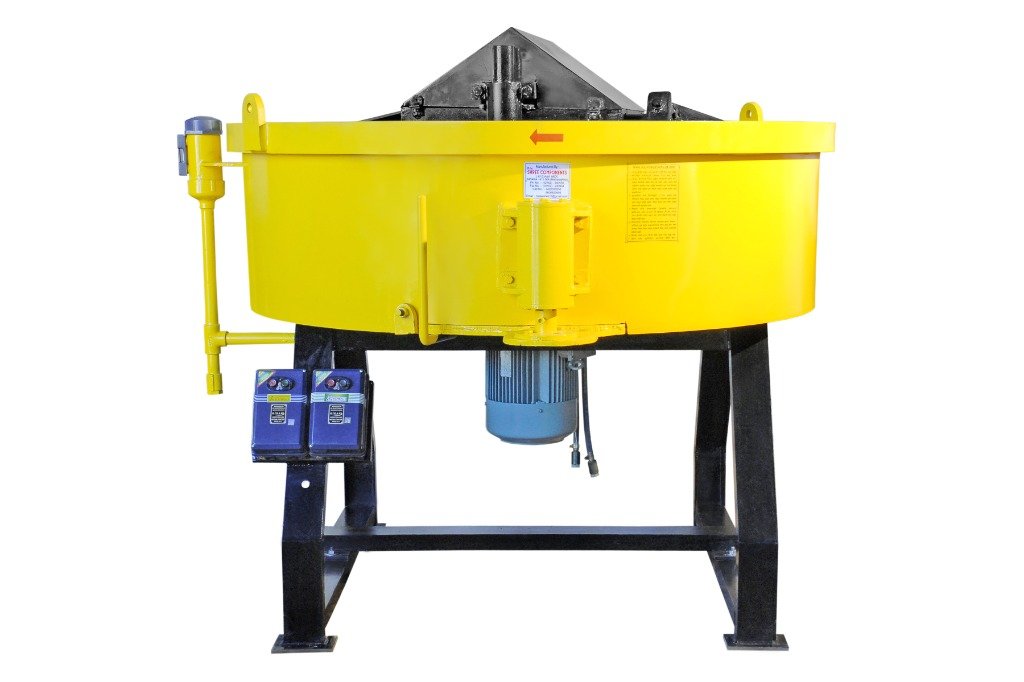
Concrete pan mixer
What is a pan mixer?
A pan mixer is an industrial vertical shaft batch mixer featuring a stationary cylindrical pan where materials are blended by blades rotating on a single vertical axis. This design is highly valued in block and brick manufacturing for its mechanical simplicity, low operating cost, and efficient blending of dry-cast or zero-slump concrete mixtures.
In the field of concrete batching, selecting the appropriate mixing equipment is critical to balancing product strength and operational costs. For standard precast blocks, fly ash bricks, and masonry mortars, high-end high-shear mixing is not always required. In these applications, the pan mixer represents the most reliable, cost-effective, and robust mechanical solution for continuous factory operations.
This comprehensive technical guide details the operating principles, wear dynamics, and core advantages of pan mixers, serving as an engineering reference for construction material producers looking to maximize production uptime.
Concrete Pan Mixer Video Demonstration
Watch our heavy-duty vertical shaft concrete pan mixer in action, demonstrating dry batch mixing and fast gravity discharge doors.
1. Operating Principles of the Pan Mixer
The pan mixer utilizes a vertical shaft design. The mixing pan itself remains stationary, which simplifies the structural installation. The drive motor, located either above or below the pan, is coupled to a high-torque gearbox that rotates a vertical drive shaft at the center of the cylinder.
Bolted to this shaft are multiple mixing arms. These arms hold mixing paddles that travel in a circular trajectory, dragging aggregates, cement, and water along the floor of the pan. Wall scraper arms are also attached to the shaft to clean the outer cylinder walls, preventing material from sticking. Blending occurs as aggregates cascade over the paddles and collide under the force of gravity. Discharge is accomplished via a sector door at the bottom of the pan, allowing gravity to empty the batch in seconds.
2. Key Operational Advantages
For brick and block yards, pan mixers offer several distinct operational benefits:
Mechanical Simplicity
With only a single rotating vertical shaft, pan mixers contain fewer gears and bearings than planetary mixers. This mechanical simplicity reduces the risk of drive system failures and ensures that routine maintenance (greasing, bearing checks) can be handled by local mechanics without specialized training.
Cost-Efficiency and Low Starting Torque
Pan mixers have a lower initial capital cost, making them ideal for budget-conscious plants. Additionally, the motor requires less starting torque compared to rotating-pan mixers. Because the pan is stationary, the motor only has to move the arms and paddles through the material, which reduces energy consumption and utility costs.
3. Wear Protection: Ni Hard Metallurgy
Aggregates like quartz sand and granite are highly abrasive, leading to fast wear rates on blades and floor plates. Standard steel components wear down in a matter of weeks, widening the gap between the blade and the floor and leaving unmixed cement stuck to the bottom of the pan.
To optimize wear life, high-quality pan mixers utilize **Ni Hard white iron castings** for all liners and paddles. Heat-treated to a minimum Brinell hardness of **550 HB**, these components resist sliding abrasion, achieving an operational life of up to 5,000 m³ of concrete throughput. Weekly clearance adjustments (maintaining a 2mm gap) ensure that the blades clean the floor, preventing aggregate build-up and keeping motor loads within design specifications.
4. Technical Comparison: Pan vs. Planetary Mixing
To help select the correct mixer for your plant, reference this operational comparison matrix:
| Operational Metric | Concrete Pan Mixer | Concrete Planetary Mixer |
|---|---|---|
| Mixing Path | Single Axis Circular | Dual Axis Cycloidal |
| Capital Cost | Low to Moderate (Highly economical) | Higher (Advanced gearbox system) |
| Ideal Formulations | Fly ash bricks, blocks, standard wet mix | UHPC, SCC, colored pavers, fibers |
| Maintenance Skill Level | Standard (Local mechanic friendly) | Medium (Requires precision gearbox checks) |
| Wear Liners | Concentrated wear along the blade path | Evenly distributed wear across floor |
Conclusion
For standard precast operations, a pan mixer is an invaluable asset that balances capital investment with high operational reliability. By selecting a unit lined with Ni Hard castings and powered by a safety-rated gearbox, plant owners can secure years of trouble-free concrete block production.
Balaji Construction Machines & Spares manufactures heavy-duty pan mixers (Models PAN 400 to PAN 900) at our Satara, Maharashtra facility. Built with 12mm floor plates, 550 HB hardness Ni Hard liners, and high-torque gearboxes, our mixers are engineered for maximum durability. Contact our sales team today to customize your mixing system.
Frequently Asked Questions (FAQ)
What is a pan mixer and how does it work?
A pan mixer is a vertical shaft batch mixer with a stationary pan. The mixing arms and paddles are attached to a central rotating shaft, dragging the aggregates along the floor in a circular trajectory to blend them under gravity.
Is a pan mixer suitable for fly ash brick plants?
Yes. A pan mixer is the industry standard for fly ash brick and hollow block plants. It handles dry-cast, zero-slump mixtures efficiently, has a low initial cost, and is simple to maintain locally.
What is the typical mixing cycle time of a pan mixer?
A concrete pan mixer achieved full batch homogeneity in 4 to 6 minutes. Cycle times can be reduced by using optimized paddle angles and automated pneumatic or hydraulic discharge gates.
How long do pan mixer blades and liners last?
Standard steel blades may wear out in 1,000 batches. Balaji's premium Ni Hard white iron blades (550 HB Brinell hardness) can withstand up to 5,000 m³ of abrasive aggregate mixing before requiring replacement.
What capacities of pan mixers are available?
Balaji manufactures the PAN 400 (400 Liter capacity), PAN 600 (600 Liter capacity), and PAN 900 (900 Liter capacity) models, which align with standard precast block machine outputs.