
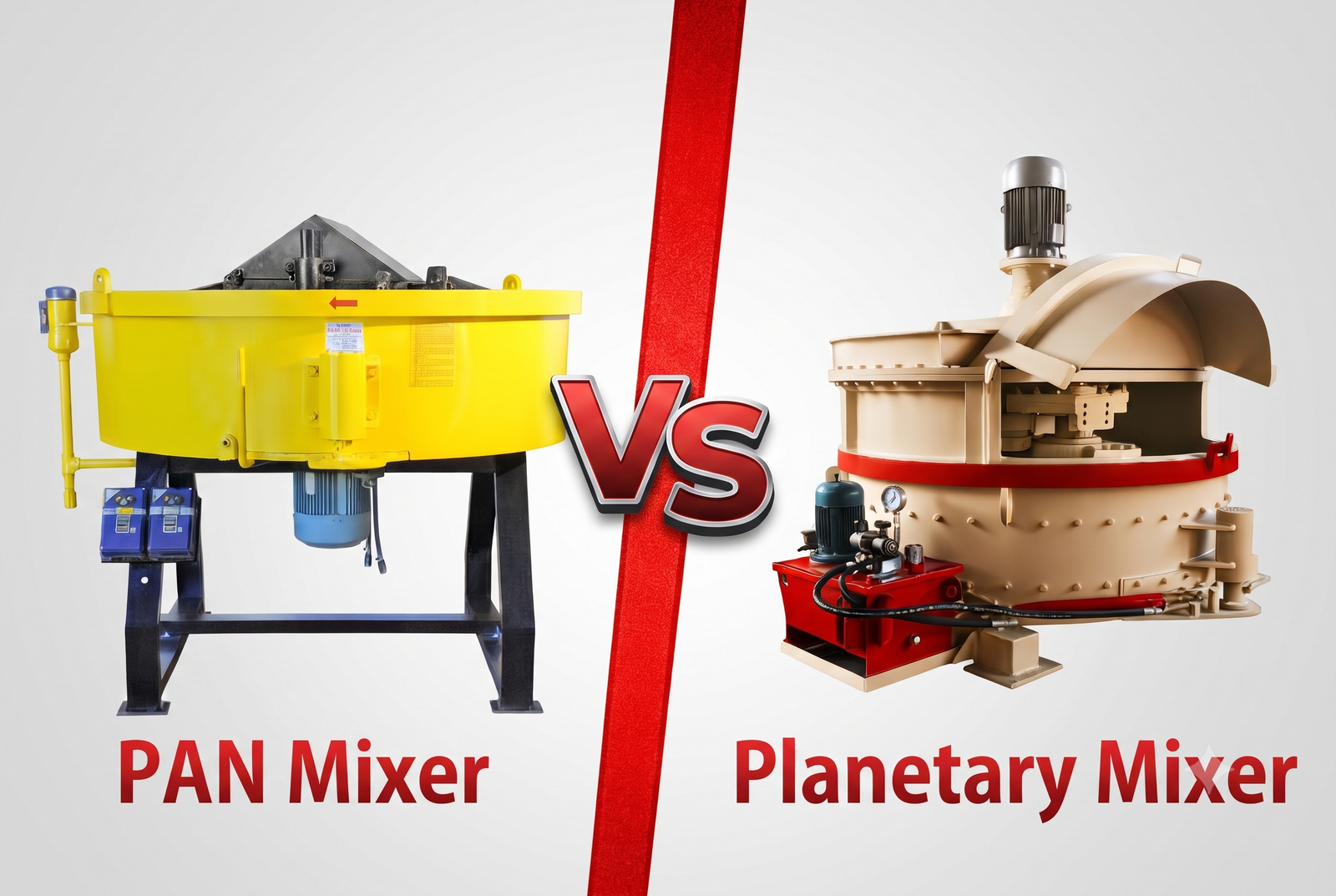
Concrete planetary mixer vs pan mixer
For infrastructure developers, concrete block manufacturers, and Ready Mix Concrete (RMC) plant managers, selecting the core mixing technology is the most critical decision in plant design. The concrete mixer is the heart of the batching system; its efficiency determines your daily output volume, material waste, strength consistency, and utility bills. When designing a new plant, the central choice lies between two main technologies: the Concrete Planetary Mixer and the traditional Concrete Pan Type Mixer.
While both types of equipment are designed to turn cement, aggregate, water, and chemicals into concrete, their mechanical principles, shear intensities, energy requirements, and initial investment structures are drastically different. This comprehensive guide compares these two mixers across every major technical parameter, helping you make a data driven decision that aligns with your operational goals and budget constraints.
1. Operating Principles and Kinematics
The primary difference between a planetary and a pan mixer lies in the kinematics of their mixing blades:
The Planetary Mixer: A planetary mixer uses a dual axis mixing mechanism. It features one or more rotating stars (turrets) that revolve around a central vertical axis inside the pan. Each star is equipped with multiple mixing paddles that rotate rapidly on their own vertical axis. This double motion (revolution and rotation) covers 100% of the pan floor area during every rotation, ensuring that material is pushed in opposing directions, lifted, and blended constantly, eliminating any potential stagnant zones.
The Pan Mixer: A pan mixer utilizes a simpler, single axis mechanism. It has a central vertical shaft that rotates within a stationary mixing pan. Multiple mixing blades and scraper arms are fixed to this shaft. As the shaft turns, the blades push the aggregates and paste in a circular path. The mixing action relies on gravity and the natural cascading of materials over the moving blades. While reliable, this single motion can result in cement pooling near the center and segregation of heavier aggregates toward the outer walls.
2. Mixing Homogeneity and Shear Intensity
The strength of cured concrete depends on how uniformly water and binders are dispersed around aggregates. In high performance concrete (such as SCC or UHPC) or dry cast mixes (such as paver blocks), binders like silica fume must be completely de-agglomerated.
Planetary mixers apply high shear force directly to the concrete paste. The counter current rotation generates extreme velocity differentials, ripping apart cement clusters and dispersing water instantly. This ensures high structural strength and completely uniform color pigment distribution in colored pavers. Pan mixers, on the other hand, apply lower shear forces, making them excellent for highly plastic, standard wet concrete batches but less suitable for dry cast or fiber reinforced mixes.
3. Mixing Speed and Batch Cycle Times
Time is money in concrete production. A planetary mixer's high intensity agitation accelerates the hydration process, reaching a perfectly homogeneous state within 2 to 3 minutes for standard concrete. This rapid cycle time allows a plant to run more batches per hour.
A traditional pan mixer requires a longer blending cycle, typically taking 4 to 6 minutes to achieve a similar level of consistency. For operations requiring high volume throughput (like large precast sleep plants), upgrading to a planetary system can boost daily capacity by up to 25% without changing the batch size.
4. Energy Efficiency and Operational Costs
Because planetary mixers achieve homogeneity faster, they consume less electricity per cubic meter of concrete produced. The motor sizing of a planetary mixer is highly optimized because the dual rotation requires less starting torque compared to a pan mixer, where a massive arm must drag the entire static weight of a dry mix at startup. Over a year of continuous operation, this translates into significantly lower electricity utility bills for the batching plant.
5. Mechanical Wear and Maintenance Costs
Pan mixers have fewer moving parts, making their gearboxes and drive shafts simple and cost effective to maintain. However, because the blades drag aggregates in a single circular path, the wear on the outer floor liners is highly concentrated, leading to uneven wear patterns and regular localized liner replacements.
Planetary mixers incorporate more complex planetary gearboxes (which we engineer with a 2.0 Factor of Safety at Balaji). While the gearbox is more sophisticated, the wear on the Ni Hard liners is distributed evenly across the entire pan floor. This even wear profile extends the lifespan of the wear castings up to 5,000 m³ and ensures that maintenance shutdowns remain highly predictable.
Head to Head Comparison Summary
| Feature | Concrete Planetary Mixer | Concrete Pan Mixer |
|---|---|---|
| Mixing Kinematics | Dual Axis (Rotation + Revolution) | Single Axis (Rotation only) |
| Dead Zones | Zero dead zones (100% floor sweep) | Possible dead zones at center & corners |
| Shear Intensity | High shear force (Excellent for UHPC/SCC) | Low/Medium shear (Good for standard mix) |
| Mixing Cycle Time | 2 to 3 minutes | 4 to 6 minutes |
| Pigment Dispersion | Excellent (Streak free coloring) | Moderate (Risk of streaks in dry cast) |
| Wear Pattern | Highly uniform wear across liners | Concentrated wear path on outer ring |
Conclusion: When to Choose Which Mixer
Choose a Concrete Planetary Mixer if: You are producing high strength precast products like interlocking paver blocks, fly ash brick wall panels, railway sleepers, or concrete pipes. It is also required if you are blending Ultra High Performance Concrete (UHPC) or colored concrete tiles where pigment consistency is critical.
Choose a Concrete Pan Mixer if: Your plant operates on a tighter initial budget, you are producing standard masonry wet concrete, or you are running a localized building block yard where cycle speed is not the primary bottleneck.
At Balaji Construction Machines & Spares, we manufacture heavy duty mixers of both configurations, customized with premium Ni Hard wear components to fit your plant requirements. Contact our engineers in Satara, Maharashtra, to receive a detailed quote.
Frequently Asked Questions (FAQ)
Is a planetary mixer always better than a pan mixer?
A planetary mixer is technically superior for dry, low water, and high strength mixes due to its dual axis counter current shearing action. However, for standard wet concrete mixes, a pan mixer is an excellent, cost effective alternative that is simpler to maintain.
Which mixer is more energy efficient for dry concrete mixes?
The planetary mixer is more energy efficient. Because its dual motion stars blend the dry materials faster, the batch reaches homogeneity in half the time of a pan mixer, reducing the electricity consumed per cubic meter of output.
What is the difference in discharge doors between planetary and pan mixers?
Both mixers can be equipped with pneumatic or hydraulic sector gates. However, planetary mixers often feature faster discharge velocities because the rotating stars actively push the concrete toward the discharge door, minimizing cycle delays.
Can paver block plants operate successfully using only pan mixers?
While standard gray paver blocks can be produced in a pan mixer, manufacturing premium, multi colored interlocking pavers requires a planetary mixer to prevent color streaking and ensure consistent concrete density across every batch.
How does initial investment cost compare between the two mixer types?
Pan mixers are more economical to purchase initially due to their simpler single shaft gear system. Planetary mixers have a higher initial capital cost due to their complex planetary gearbox and dual axis assemblies, but they deliver a higher ROI over time through faster production speed and reduced cement consumption.