Heavy-duty mixers designed for standard concrete blends, dry mortars, and precast applications.
Reliable, cost-effective mixers manufactured for standard industrial blocks and tile plants.
Capacity: 400 Liters
Output per Batch: ~300 kg
Mixing Motor: 7.5 HP
Blades Type: Segmented wear-resistant castings.
Capacity: 600 Liters
Output per Batch: ~450 kg
Mixing Motor: 10.0 HP
Blades Type: Segmented wear-resistant castings.
Capacity: 900 Liters
Output per Batch: ~700 kg
Mixing Motor: 15.0 HP
Blades Type: High hardness segment castings.
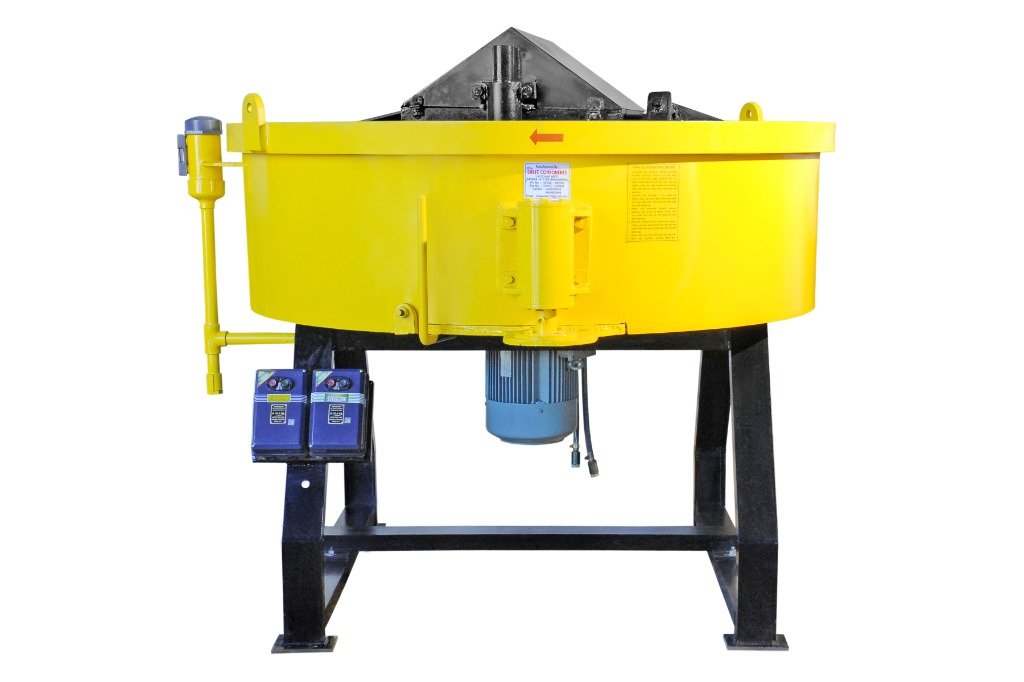
Our state of the art pan mixer range is manufactured at our MIDC Satara facility in Maharashtra, India, to deliver exceptional mixing homogeneity for dry, semi dry, and wet concrete aggregates. Outfitted with high-torque vertical drive systems, these mixers are built to withstand rigorous operation in paver block, fly ash brick, and precast concrete manufacturing environments.
Unlike traditional gravity-fed drum mixers, our forced action mechanism uses a stationary circular pan combined with multiple high-wear segmented mixing paddles and side scrapers. This design forces raw materials to collide continuously, eliminating aggregate segregation, shortening mixing cycles to 2-3 minutes, and optimizing cement consumption.
Understand the operational and technical differences to choose the correct machinery for your plant.
| Sr | Aspect | Concrete Planetary Mixer | Concrete Pan Type Mixer |
|---|---|---|---|
| 1 | Mixing Mechanism | Dual motion: blades rotate and revolve around a central axis, ensuring complete coverage of the mixing area. | Blades rotate within a stationary pan, mixing concrete in a single motion. |
| 2 | Mixing Efficiency | Very high efficiency due to planetary motion covering all parts of the batch. | High efficiency, but slightly less than planetary mixers due to a single motion. |
| 3 | Mixing Homogeneity | Excellent mixing homogeneity, especially for complex mixes such as SCC and UHPC. | Provides good homogeneity but may require slightly more mixing time to achieve similar results. |
| 4 | Mixing Speed | Faster mixing due to dual-motion design, typically reduces mixing time by 10-15% compared to pan mixers. | Slightly slower; typically takes 5-10 minutes per batch depending on mix type. |
| 5 | Material Handling | Suitable for all concrete types, including fiber-reinforced and high-strength concrete. | Works well with standard concrete mixes, but may not be as efficient for fiber-reinforced or ultra-high-strength concrete. |
| 6 | Mixing Time | 2 to 5 minutes per batch depending on material and mixer capacity. | 5 to 8 minutes per batch for standard mixes. |
| 7 | Blade Design | Multiple high-efficiency blades rotating and revolving, ensuring uniform mixing with minimal dead zones. | Single set of rotating blades scraping the pan surface, less complex than planetary mixers. |
| 8 | Mixing Capacity | Ranges from 0.5 to 3 cubic meters per batch. | Typically ranges from 100 to 1000 liters per batch. |
| 9 | Blade Speed | 10 to 40 rpm depending on the phase of mixing. | 20 to 40 rpm depending on the mixer model. |
| 10 | Energy Consumption | More energy-efficient for complex and large-volume mixing tasks due to optimized motion. | Slightly higher energy consumption for equivalent batch sizes due to longer mixing time. |
| 11 | Motor Power | 15 to 150 kW depending on size and model. | 5 to 30 kW depending on size and application. |
| 12 | Maintenance | Moderate: requires regular inspection and lubrication, but durable over long periods. | Low: fewer moving parts result in easier maintenance, although blades may wear quicker. |
| 13 | Application Versatility | Highly versatile for high-performance concrete, precast, refractory materials, and SCC. | Primarily suited for regular concrete production and masonry mixes. |
| 14 | Structural Durability | Built with high-grade steel, designed for heavy-duty industrial use, resistant to wear and tear. | Also highly durable but less robust for extreme applications like ultra-high-performance concrete. |
| 15 | Mixing Intensity | High-intensity mixing, especially useful for dry and fiber-reinforced mixes. | Moderate mixing intensity, better for semi-dry and standard mixes. |
| 16 | Weight | 1.5 to 15 tons depending on the model. | 0.5 to 2 tons, typically lighter than planetary mixers. |
| 17 | Space Requirements | Requires more space due to complex mechanical design. | Compact and space-efficient, ideal for smaller sites. |
| 18 | Discharge System | Usually features a hydraulic or pneumatic discharge system for quick release. | Features bottom or side discharge, typically manual or hydraulic. |
| 19 | Cost | Generally more expensive due to the complex design and high-efficiency output. | More affordable, making it suitable for small to medium-sized operations. |
| 20 | Production Consistency | Ensures highly consistent production quality, even with large and complex batches. | Provides good consistency, but may vary slightly in larger or more complex batches. |
Get answers to the most common questions regarding operation, specs, and applications of pan mixers.